CJC-1295 vs ipamorelin vs both: how they differ, why they're paired, and where tesamorelin sits

The short answer
CJC-1295 is a long-acting GHRH analog; ipamorelin mimics ghrelin at a separate receptor. Both push the pituitary to release more of the body's own growth hormone, which is why they are paired. Human data for both is small and about hormone levels, not muscle. Tesamorelin is a GHRH analog like CJC-1295, but with a large randomized trial and an FDA approval.
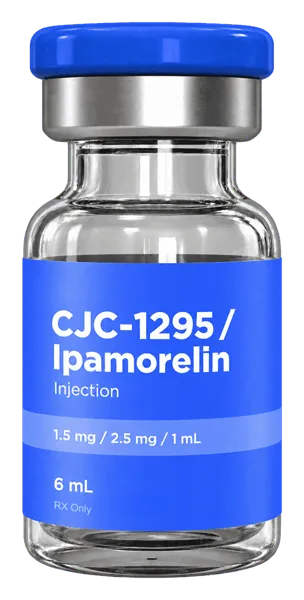
CJC-1295 and ipamorelin
Two peptides that push the pituitary to release more of the body's own growth hormone, through different switches.
- Long-acting analog of growth hormone-releasing hormone (GHRH)
- Selective growth hormone secretagogue acting on the ghrelin receptor
- Injectable peptides
- Small, short studies that measured GH and IGF-I, not muscle
“CJC-1295 vs ipamorelin, which one, or both?” is the question that opens most peptide forum threads, and the useful answer is not a recommendation but an explanation. These two are not competing versions of the same thing; they are different molecules that raise the body’s own growth hormone (GH) through different receptors, which is precisely why they are so often described as a pair rather than an either/or. Lately a third name keeps joining the thread: tesamorelin, which works like CJC-1295 but has a far deeper research record. This page compares them honestly on what each one is, how the mechanisms differ, what the human research actually measured, how the side effects compare, and why “both” is the phrase you keep seeing, sourced to the primary literature and to what lifters running them report. For the deeper single-topic treatment, see our companion guide on what CJC-1295 and ipamorelin actually do, or the hub overviews of CJC-1295 and ipamorelin.
What is the difference between CJC-1295 and ipamorelin?
CJC-1295 and ipamorelin are two different synthetic peptides that both increase GH release, but they belong to separate pharmacological classes. CJC-1295 is a long-acting analog of growth hormone-releasing hormone, the natural hypothalamic signal (GHRH) that tells the pituitary to secrete GH; it was studied in humans as a version engineered to last far longer than the body’s own releasing hormone (Teichman et al., 2006). Ipamorelin is a small five-amino-acid peptide, a pentapeptide, from a different class called growth hormone secretagogues; it mimics the hormone ghrelin at ghrelin’s receptor to trigger a separate GH-release pathway (Raun et al., 1998). Neither is a steroid, neither is growth hormone itself, and neither is an approved medicine for building muscle. One more distinction matters before any comparison: “CJC-1295” is itself two molecules, the long-acting form built with a drug-affinity complex (CJC-1295 with DAC) that was used in the published human trials, and a shorter-acting variant often labeled “modified GRF 1-29” or “CJC-1295 without DAC” that is more common in community use. The citable human data belong to the DAC form.
What does CJC-1295 do?
CJC-1295 raises the body’s own GH and IGF-I for days at a time after a single injection. In healthy adults, one injection of the DAC form produced “dose-dependent increases in mean plasma GH concentrations by 2- to 10-fold for 6 d or more and in mean plasma IGF-I concentrations by 1.5- to 3-fold for 9-11 d” (Teichman et al., 2006). Those are hormone measurements in small pharmacology trials (small human trials, in evidence terms); no published human study has measured what CJC-1295 does to muscle, strength or body fat. The DAC form is not the only one sold; CJC-1295 with DAC vs no DAC explains why that matters.
What does ipamorelin do?
Ipamorelin triggers a pulse of GH release through the ghrelin receptor, and its founding research stood out for how narrowly it did that. It released GH in rat pituitary cells, rats and pigs, and in pigs it did not raise ACTH or cortisol beyond the levels seen after GHRH itself (Raun et al., 1998). In people, its one completed efficacy trial was for bowel recovery after surgery, not physique, and it did not beat placebo (Beck et al., 2014). The evidence level is mostly animal studies plus one negative human trial.
How do the two mechanisms differ?
The mechanisms diverge at the very first step: the two peptides press different buttons on the same gland. CJC-1295 acts on the GHRH receptor, doing what the body’s own releasing hormone does but over a far longer window, with an estimated half-life of roughly six to eight days in its human trial (Teichman et al., 2006). Ipamorelin acts on the growth hormone secretagogue (ghrelin) receptor, a separate switch, and its defining feature in the founding research was selectivity: it released GH strongly but “did not release ACTH or cortisol in levels significantly different from those observed following GHRH stimulation,” and the authors described it as “the first GHRP-receptor agonist with a selectivity for GH release similar to that displayed by GHRH” (Raun et al., 1998). So the difference is not “stronger versus weaker”, it is two independent GH-release pathways, one sustained and GHRH-based, one pulse-like and ghrelin-based.
Why are CJC-1295 and ipamorelin discussed together?
Because they act on different receptors, the theory is that combining them produces a larger, more physiological GH pulse than either alone, and that mechanistic rationale, not a proven result, is the entire reason the two are marketed as a stack. A GHRH analog like CJC-1295 raises the baseline “keep releasing GH” signal, while a ghrelin mimetic like ipamorelin adds a separate pulse on top; on paper the two pathways are complementary rather than redundant. Ipamorelin in particular became the community’s preferred pairing partner because of its clean profile: unlike older secretagogues such as GHRP-6, it left cortisol, prolactin, and other hormones essentially undisturbed in the original study (Raun et al., 1998). It is worth being precise about what “used together” rests on, though. There is no published human trial that tested the CJC-1295 plus ipamorelin combination for muscle, strength, fat loss, or recovery. The pairing is a biologically reasonable hypothesis about GH dynamics, not a demonstrated body-composition outcome, a distinction the marketing routinely erases.
What does the human research on each actually show?
For both peptides, the human evidence is small, short, and about hormone levels rather than physique. CJC-1295 has two published human studies in healthy adults: the first, itself a pair of randomized, placebo-controlled trials, established the GH and IGF-I rises above and reported the drug was “safe and relatively well tolerated” at the doses tested (Teichman et al., 2006); a second, an open dose-comparison study, found that the sustained stimulation did not flatten the body’s natural rhythm, reporting that “CJC-1295 increased trough and mean GH secretion and IGF-I production with preserved GH pulsatility” (Ionescu & Frohman, 2006). Both are genuine pharmacology findings, the drug raises the hormones it is meant to raise, but the endpoints are blood assays in a few dozen volunteers over days to weeks, not muscle. Ipamorelin’s human record is thinner still and, crucially, negative where it was tested: its one completed clinical trial advanced the peptide into a Phase 2 study not for physique but for postoperative ileus (the temporary shutdown of bowel function after surgery), and in 114 patients it missed its endpoint, median time to first tolerated meal was 25.3 hours with ipamorelin versus 32.6 hours with placebo, a difference that was not statistically significant (p = 0.15), with “no significant differences between ipamorelin and placebo in the key and secondary efficacy analyses” (Beck et al., 2014). Neither peptide has a published human trial measuring muscle growth or body recomposition at all. PeptideAgent’s CJC-1295 vs ipamorelin comparison reads the same two records and favors CJC-1295 on human data, while noting that the two sit in the same place legally.
Tesamorelin vs CJC-1295: where does tesamorelin sit?
Tesamorelin belongs on CJC-1295’s side of this comparison, not ipamorelin’s: both are GHRH analogs that act on the GHRH receptor. The Egrifta SV label describes tesamorelin as a growth hormone-releasing factor analog that, in lab testing, “binds and stimulates human GRF receptors with similar potency as the endogenous GRF” (Egrifta SV label, DailyMed). Where the two split is the paper trail. CJC-1295 is not FDA-approved for any use; tesamorelin is FDA-approved only as Egrifta, for “the reduction of excess abdominal fat in HIV-infected adult patients with lipodystrophy,” and the label adds that it is “not indicated for weight loss management” (Egrifta SV label).
The human evidence gap is the bigger story. In a randomized, placebo-controlled trial, 412 patients with HIV and excess abdominal fat received a daily injection of tesamorelin or placebo for 26 weeks; visceral fat “decreased by 15.2% in the tesamorelin group and increased by 5.0% in the placebo group,” and IGF-I rose 81.0% in the tesamorelin group (Falutz et al., NEJM 2007). That is a body-composition outcome in a large trial, something CJC-1295 has never had, though it is deep belly fat in people with HIV, not muscle in lifters. The label’s most common side effects are joint pain, injection-site redness and itching, pain in the arms or legs, swelling of the limbs (peripheral edema) and muscle aches (Egrifta SV label). Since tesamorelin and ipamorelin act on different receptors, the same pairing logic applies to them; we compare those two in depth in tesamorelin vs ipamorelin, and line tesamorelin up against the other well-known GHRH analog in tesamorelin vs sermorelin. The hub overview of tesamorelin covers the drug on its own.
CJC-1295 vs ipamorelin vs tesamorelin, side by side
The table maps the three peptides across the dimensions that actually distinguish them: class, receptor, duration, what the research measured, and sport status. Read it as a description of where each one sits, not as a recommendation to use any of them; the honest takeaway is how much they have in common at the point that matters most to a lifter, namely the absence of human muscle-growth evidence.
| Attribute | CJC-1295 | Ipamorelin | Tesamorelin |
|---|---|---|---|
| Peptide class | Long-acting GHRH analog (GH-releasing hormone) | Growth hormone secretagogue (ghrelin mimetic / pentapeptide) | GHRH analog (growth hormone-releasing factor analog) |
| Receptor acted on | GHRH receptor | Growth hormone secretagogue (ghrelin) receptor | GHRH receptor |
| Duration of action | Long: ~6-8 day half-life for the studied DAC form | Short-acting; drives a pulse of GH release | Given as a daily injection in its trials |
| Signature research finding | Raised GH 2-10x and IGF-I 1.5-3x; pulsatility preserved | Released GH without raising ACTH, cortisol, prolactin, or TSH | Visceral fat down 15.2% vs up 5.0% on placebo over 26 weeks; IGF-I up 81% |
| Completed human trials | Two small placebo-controlled pharmacology trials (hormone levels) | One Phase 2 trial (postoperative ileus), did not beat placebo | One large randomized placebo-controlled trial cited here (412 patients, 26 weeks) |
| Human muscle-growth trials in lifters | No | No | No |
| Approved by the FDA for any use | No | No | Only as Egrifta, for HIV-related abdominal fat |
| WADA status (sport) | Prohibited at all times (S2) | Prohibited at all times (S2) | Prohibited at all times (S2) |
How do the side effects of CJC-1295 and ipamorelin compare?
In the few human trials that exist, both peptides were reported as reasonably well tolerated, but neither has been followed long enough to describe long-term safety. CJC-1295’s two trials ran 28 and 49 days in healthy adults and reported that “no serious adverse reactions were reported” (Teichman et al., 2006). Ipamorelin was well tolerated in its 114-patient post-surgery trial (Beck et al., 2014). Beyond that, the expected downsides follow from the mechanism: raising GH and IGF-I is associated with fluid retention, joint aches and effects on blood sugar, and the long-acting CJC-1295 form keeps GH elevated for days rather than in short pulses. Ipamorelin’s selling point in the research was that it raised GH without raising cortisol or prolactin in animals (Raun et al., 1998), which is a narrower hormonal footprint, not proof of long-term safety. Tesamorelin, by contrast, has a label-level side-effect list from large trials, summarized in the section above. Our page on CJC-1295 and ipamorelin side effects lists what each small study recorded. Our page on GH peptide side effects and realistic expectations covers the growth-hormone side-effect data in detail.
Are CJC-1295 and ipamorelin allowed in sport?
No, both are prohibited in sport at all times, and so is tesamorelin. WADA groups growth hormone-releasing factors and secretagogues together in category S2; CJC-1295 is “explicitly listed as a prohibited substance on the WADA Prohibited List (Section S2.2.4) as a growth hormone releasing factor,” with the “prohibition applies at all times, both during and outside of competition” (BSCG). The Prohibited List names CJC-1295 and tesamorelin together as examples of GHRH analogues, and names ipamorelin among the growth hormone secretagogues (WADA Prohibited List). On the question tested athletes care about most, the three are identical: none is allowed.
What do people running CJC-1295 and ipamorelin report?
In public posts, people mostly describe the two as a team rather than rivals, and they disagree more about which CJC-1295 form to use than about which peptide to pick. Our Community Insights summaries of public posts on X (17 posts on CJC-1295 from July 13 to 19, 2026, and 16 on ipamorelin from July 15 to 16, 2026) found these themes; they are anecdotes, not evidence:
- Ipamorelin as a starting point. Some posters describe ipamorelin as a common first growth-hormone peptide because of what they call a clean side-effect profile, an opinion rather than a consensus.
- Pulses versus replacement. Several argue that secretagogues like ipamorelin and CJC-1295 prompt the body’s own GH pulses rather than replacing the hormone, which they see as a reason to prefer them over injecting GH directly. That is user reasoning, not a tested outcome.
- DAC or no DAC. Posters treat the two CJC-1295 forms as different peptides; some favor DAC for convenience and cost, others worry its continuous GH elevation could bring insulin resistance.
- Side effects. Reports include facial flushing, worse sleep, and concerns about insulin resistance and high IGF-1, with disagreement about how serious those risks are.
- Where tesamorelin lands. Commenters note that tesamorelin is the only approved GHRH analog; one shared tier list ranked it above CJC-1295 and ipamorelin, and one user said CJC-1295 won on cost but caused sleep problems that tesamorelin did not.
So is it “CJC-1295, ipamorelin, or both”?
The framing of the question assumes one option is clearly better, and the honest answer is that the evidence cannot rank them for physique. What genuinely differs between CJC-1295 and ipamorelin is mechanism and research history: a sustained GHRH analog with two hormone-level trials versus a selective ghrelin mimetic with one negative efficacy trial. “Both” is popular because the two act on different receptors, a reasonable hypothesis that no human trial has tested for muscle or fat loss. Tesamorelin is the GHRH analog with real trial depth, but its proven effect is on visceral fat in people with HIV, not on muscle. What does not differ is the part that decides the most for a lifter: no human muscle data and a WADA ban for all three. If your real goal is muscle, recovery, or a leaner body composition, weigh any of these options against those facts, ideally with a clinician who knows your labs. The guide on what CJC-1295 and ipamorelin actually do goes deeper on each, and tesamorelin vs ipamorelin covers the other common pairing.
Status: CJC-1295 and ipamorelin are not FDA-approved; sold by some telehealth providers as a compounded prescription. Tesamorelin is FDA-approved only as Egrifta, for HIV-related abdominal fat; other uses are off-label. What this status means.
Educational information only, not medical advice. Every efficacy and safety statement on this page is sourced to the peer-reviewed literature or drug label linked above, and every anti-doping statement to the WADA Prohibited List or WADA-aligned documents; the community summary reflects public posts on X analyzed in July 2026. Updated October 12, 2026. This page is drafted with AI assistance and fact-checked against the cited primary sources before publication.
Sources (8)
Advertising disclosure: links marked "Paid link" go to Bodybuilding Peptides (trybbpeptides.com), an affiliate destination, and Recomp Lab may earn a commission if you buy there. Our coverage is independent of that relationship, and nothing on this page is medical or legal advice.
 See it at Bodybuilding Peptides