Does tesamorelin help build muscle? The claim, graded against what the trials measured
The short answer
Not in the way the gym floor claims. Tesamorelin's trials were built to shrink visceral belly fat in adults with HIV, and they measured fat and IGF-1, not strength. Lean body mass, a scan measure that counts water as well as muscle, rose about 1.2 to 1.4 kg and fell back after stopping. No trial has tested it in healthy lifters.
Scroll any physique forum long enough and tesamorelin shows up as the “clean” growth-hormone peptide: the approved one, the one that strips belly fat, and, depending on who is posting, the one that builds muscle while you recomp. That last claim is the one worth checking, because tesamorelin is unusual among the peptides lifters talk about. It has real, large, placebo-controlled trials behind it. They just were not designed to answer the question lifters are asking. This page grades the muscle claim against what those trials actually measured, then sets that next to what the community says it sees.
Does tesamorelin help build muscle?
There is no trial showing that tesamorelin builds muscle or strength in healthy people who lift, because none has been run. What the evidence does show is narrower. In adults with HIV and excess abdominal fat, 26 weeks of daily tesamorelin raised lean body mass by about 1.2 to 1.3 kg on DXA scans, against essentially no change on placebo (Egrifta WR label, DailyMed), and a 2026 meta-analysis of five randomized trials put the pooled gain at 1.42 kg (Badran et al., 2026). Lean body mass is not the same thing as muscle: the scan counts water and other non-fat tissue too, and fluid retention is a labeled side effect. So the honest grade is “some lean-mass signal in a clinical population, muscle and strength untested.”
What is tesamorelin?
Tesamorelin is a synthetic analog of growth hormone-releasing hormone (GHRH), the brain’s signal that tells the pituitary to release growth hormone. It is FDA-approved as Egrifta, and the current label limits its indication to reducing excess abdominal fat in adults with HIV and lipodystrophy. The same label says it is not indicated for weight loss management because it has a weight-neutral effect, and that its long-term cardiovascular safety has not been established (Egrifta WR label). It raises your own growth hormone and, downstream, IGF-1; it is not growth hormone itself. For the full overview, see our network’s tesamorelin guide.
Why do lifters use tesamorelin for recomp?
Lifters reach for tesamorelin because the one thing it reliably does in trials, shrink visceral fat, sounds like half of a recomp, and the growth-hormone mechanism sounds like the other half. The reasoning goes: more GH and IGF-1 means more muscle, less belly fat means a leaner midsection, and the FDA approval means it is the “real” version of what CJC-1295 promises. Each step in that chain is a claim about outcomes, and only the belly-fat step has been measured directly. The rest of this page takes each step in turn.
What did the tesamorelin trials actually measure?
The tesamorelin trials measured visceral fat on CT as their primary endpoint, with lipids, IGF-1 and body image as secondary endpoints; muscle and strength were never primary or secondary endpoints. The evidence level here is strong for what it covers: an approved drug, labeled use, backed by large randomized, double-blind trials.
- The first phase 3 trial randomized 412 adults with HIV (86% men) to 2 mg tesamorelin or placebo daily for 26 weeks. Visceral fat fell 15.2% on tesamorelin and rose 5.0% on placebo, triglycerides dropped, and IGF-1 rose 81% (Falutz et al., 2007).
- The pooled analysis of both phase 3 trials (806 patients) found a treatment effect of minus 15.4% on visceral fat at 26 weeks, no significant change in fat under the skin, and a mean IGF-1 rise of 108 ng/mL (Falutz et al., 2010).
- The label lists lean body mass among “other endpoints,” a tier below the secondary ones, and reports the 1.3 kg and 1.2 kg gains from the two trials alongside a trunk-fat loss of 1.0 kg and 0.8 kg (Egrifta WR label).
- Outside HIV, the main randomized trial gave 60 abdominally obese adults with reduced GH secretion tesamorelin or placebo for 12 months. Visceral fat, triglycerides, C-reactive protein and carotid wall thickness improved, and IGF-1 rose. DXA lean body mass rose 1.4 kg more than on placebo, though the authors noted some of that might be fluid and shifts in body water; strength was not measured (Makimura et al., 2012).
Notice what is missing. Nobody was lean, nobody was trained, nobody was lifting on a program, and nobody’s bench press or squat was recorded.
Did tesamorelin increase muscle in any study?
One exploratory analysis looked directly at muscle, and it found small increases in trunk muscle area and density. Researchers re-read the CT scans from the two phase 3 trials, but only for tesamorelin “responders,” people whose visceral fat fell at least 8%, compared with placebo. Over 26 weeks the responders gained about 0.6 to 1.1 square centimeters of lean muscle area in each of four trunk muscle groups, plus higher muscle density, which suggests less fat inside the muscle (Adrian et al., 2019).
That is a real finding, and it is also exactly where the claim stops. The authors wrote that the clinical relevance of these changes for muscle strength and function remained to be established, noting the phase 3 trials did not collect measures of muscle function, the analysis excluded non-responders, the participants were adults with HIV rather than athletes, and the measurement was a slice of the trunk, not arms, legs or total muscle. A trial built to test tesamorelin on physical function, TRIUMPH, pairs it with a home exercise program in 100 sedentary adults aged 50 to 80 with HIV; its protocol was published in July 2026, with results still to come (Erlandson et al., 2026).
Lean mass is not muscle: why the scan number misleads
A DXA “lean body mass” number includes muscle, organs, and body water, so a growth-hormone drug that causes fluid retention can move it without adding contractile tissue. The Egrifta label says fluid retention is thought to come from the rise in growth hormone and shows up as swelling, joint pain and carpal tunnel symptoms (Egrifta WR label). The same pattern appears with growth hormone itself: a systematic review of trials in fit young adults found GH raised lean body mass by 2.1 kg, yet strength and exercise capacity did not seem to improve, while edema and fatigue were more common (Liu et al., 2008). If injected GH did not appear to make fit young adults stronger in those mostly short trials, a lean-mass reading of about a kilogram in a clinical population is weak evidence that tesamorelin will.
Tesamorelin before and after: what can the trials tell you?
The trials give you a measured before and after, but for visceral fat and blood markers, not physiques. The “before and after” posts that drive this search compare photos, where lighting, pump, diet, training block, and any other compounds run at the same time all change the picture. Our page on realistic expectations for GH peptides covers why photo comparisons are the weakest form of evidence in this space.
The most useful before-and-after data in the trials is what happened after people stopped. In the extension phase, patients switched from tesamorelin to placebo regained visceral fat (up 22% and 16% in the two studies over the next 26 weeks) and lost lean body mass (down 1.8 kg and 1.7 kg), while those who stayed on the drug held their week-26 numbers (Egrifta WR label). Whatever tesamorelin added, it did not keep once the drug was gone.
Does tesamorelin work?
Yes, for what it was approved to do, and with a catch even there. Across the phase 3 trials it cut visceral fat by about 15% relative to placebo and kept it down through 52 weeks for people who stayed on it (Falutz et al., 2010). Not everyone responds: the trials defined a responder as anyone with at least an 8% visceral-fat drop, and the metabolic benefits tracked with that response (Stanley et al., 2012). The label separately tells prescribers to weigh continuing treatment in patients whose visceral fat has not fallen. For building muscle in healthy lifters, “does it work” has no tested answer.
How long does tesamorelin take to work?
In the trials, measurable changes appeared over weeks to months, not days. In a 12-week dose-ranging study, the 2 mg dose cut trunk fat by 9.2% versus a 0.8% rise on placebo (Falutz et al., 2005). The phase 3 trials judged visceral fat at 26 weeks (Falutz et al., 2007), and the label notes IGF-1 climbing above the normal range as early as 13 weeks in some patients (Egrifta WR label). Those are timelines for fat and IGF-1 in the trial populations; there is no measured timeline for muscle. The same is true of CJC-1295 and ipamorelin, as our page on how long CJC-1295 and ipamorelin take to work shows.
Does tesamorelin increase testosterone?
There is no evidence that it does. Testosterone is controlled by the pituitary hormone LH, and the Egrifta label reports no clinically significant changes in LH, TSH, ACTH or prolactin in its clinical trials (Egrifta WR label). Testosterone itself was not among the outcomes in the trials we reviewed. If you are already on testosterone therapy and wondering how GH peptides fit, our page on peptides while on TRT covers that combination.
What are the side effects of tesamorelin?
The labeled side effects follow from raising growth hormone: fluid retention, joint and muscle aches, numbness or tingling, injection-site reactions, and a higher risk of blood-sugar problems. In the combined 26-week trials, injection-site reactions occurred in 17% on tesamorelin versus 6% on placebo, joint pain in 13% versus 11%, muscle pain and peripheral swelling in 6% versus 2% each, and tingling in 5% versus 2% (Egrifta WR label).
The label’s bigger warnings are worth reading in full if you are considering it:
- Blood sugar. More patients developed an HbA1c of 6.5% or higher on tesamorelin than on placebo (5% versus 1%).
- IGF-1 overshoot. At 26 weeks, 47% of patients had IGF-1 more than two standard deviations above normal; the label says the effects of prolonged IGF-1 elevation are unknown.
- Active cancer. It is contraindicated with active cancer, because it raises growth hormone, a known growth factor; any past cancer should be inactive and treated before starting.
- Pregnancy is a contraindication.
More patients on tesamorelin than placebo also dropped out of the first phase 3 trial because of an adverse event (Falutz et al., 2007). Tesamorelin is also banned in tested sport: WADA lists it by name among GHRH analogues in category S2 (WADA Prohibited List).
Tesamorelin vs CJC-1295, ipamorelin and growth hormone
Tesamorelin has far more human data than CJC-1295 or ipamorelin, but none of the three has a muscle trial in healthy lifters, and growth hormone itself raised lean mass in fit young adults without a clear strength gain. Our growth hormone peptides guide and the CJC-1295 vs ipamorelin comparison go deeper on the other compounds.
| Attribute | Tesamorelin | CJC-1295 | Ipamorelin | Growth hormone |
|---|---|---|---|---|
| What it is | GHRH analog | Long-acting GHRH analog | Ghrelin-receptor GH secretagogue | The hormone itself |
| Largest human evidence | Phase 3 trials, 806 patients with HIV | Two small dose-ranging trials in healthy adults | One Phase 2 trial after bowel surgery | Many trials, including in fit young adults |
| Primary outcome measured | Visceral fat on CT | GH and IGF-1 levels | Time to first tolerated meal after surgery (no significant difference from placebo) | Varies by trial |
| Lean mass finding | About 1.2 to 1.4 kg gain in HIV trials; lost after stopping | Not reported in those trials | Not reported in that trial | 2.1 kg gain in fit young adults; strength did not seem to improve |
| Muscle trial in healthy lifters | None | None | None | No strength benefit shown |
| WADA (sport) | Prohibited (S2) | Prohibited (S2) | Prohibited (S2) | Prohibited (S2) |
Table sources: Egrifta WR label and Falutz et al., 2010 for tesamorelin; Teichman et al., 2006 for CJC-1295, two placebo-controlled dose-ranging trials in healthy adults that measured GH and IGF-1; Beck et al., 2014 for ipamorelin, a phase 2 trial in 114 analyzed bowel-surgery patients; Liu et al., 2008 for growth hormone; the WADA Prohibited List for sport status.
On blends: tesamorelin is often sold or stacked with ipamorelin, on the logic that GHRH and ghrelin-pathway signals add up. A PubMed search on October 12, 2026 for tesamorelin with ipamorelin returned review articles, not a human trial of the combination, so any claim about what the blend does for muscle is extrapolation.
What does tesamorelin cost?
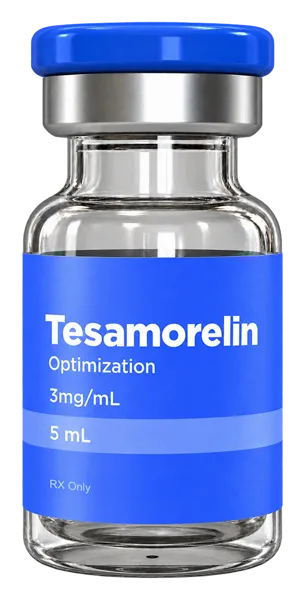
There are two very different prices. Egrifta, the approved brand, is a prescription drug whose cost depends on insurance and pharmacy, and we have not verified a list price, so we do not print one. Tesamorelin is also sold online as a separate, non-Egrifta product: the one listed in the “Where it’s sold” card on this page was a 3 mg/mL injectable in a 5 mL vial at $220 for one month, or $180 a month on a three-month plan, when we checked on October 12, 2026. That product is not Egrifta. Given that the trial benefits faded after stopping, the relevant cost is a monthly one for as long as you stay on it.
What the community is saying about tesamorelin
We do not yet have a dedicated Community Insights sample for tesamorelin, so this section draws only on where it came up in our summaries for CJC-1295 (17 public posts on X, July 13 to 19, 2026) and ipamorelin (16 public posts on X, July 15 to 16, 2026). These are anecdotes, not evidence.
- The approved one. Posters repeatedly describe tesamorelin as the only approved GHRH and treat CJC-1295 as the unapproved alternative to it.
- Rankings. One tier list placed tesamorelin, along with growth hormone, above CJC-1295, ipamorelin and sermorelin.
- Cost versus tolerability. Users comparing the two GHRH analogs disagreed, some preferring CJC-1295 on cost and others tesamorelin on tolerability; one said CJC-1295 wrecked their sleep in a way tesamorelin did not.
- Mechanism talk. Commenters group tesamorelin with peptides that prompt the body’s own GH release, which some prefer over injecting growth hormone.
What stands out is what is absent: in these samples, tesamorelin appears as a comparison point and a tolerability pick, not as the subject of measured muscle gains. That matches the literature better than the “recomp tool” reputation does. Our CJC-1295 guide has the full physique-angled community summary for that stack.
The verdict on tesamorelin and muscle
Graded against what was measured, the claim “tesamorelin builds muscle” is unsupported for healthy lifters and only weakly supported in the clinical populations studied. The visceral-fat effect is real and replicated. The lean-mass gain is real on the scan but small, partly confounded by fluid, and reversed after stopping. The trunk-muscle signal comes from an exploratory analysis of responders only. Strength, performance and total muscle have not been tested at all. If your goal is muscle, the decision should rest on that record, and a clinician who knows your labs is the right person to weigh it with you.
Status (tesamorelin): FDA-approved only as Egrifta, for HIV-related abdominal fat; other uses are off-label. What this status means.
Educational information only, not medical advice. Every efficacy and safety statement on this page is sourced to the FDA label, peer-reviewed trials and reviews linked above, and the anti-doping statement to WADA; the community summary reflects public posts on X from July 2026. Updated October 12, 2026. This page is drafted with AI assistance and fact-checked against the cited primary sources before publication.
Sources (13)
Advertising disclosure: links marked "Paid link" go to Bodybuilding Peptides (trybbpeptides.com), an affiliate destination, and Recomp Lab may earn a commission if you buy there. Our coverage is independent of that relationship, and nothing on this page is medical or legal advice.
 See it at Bodybuilding Peptides