Peptides while on TRT: what GH peptides add for a lifter, and what the evidence shows

The short answer
For a lifter already on TRT, GH peptides such as CJC-1295 and ipamorelin add a second hormone axis, raising growth hormone and IGF-1 in small human studies. What they have not shown is extra muscle: no cited trial measured physique outcomes or tested them alongside testosterone, and in animal research ipamorelin left the hormones behind testosterone production unchanged.
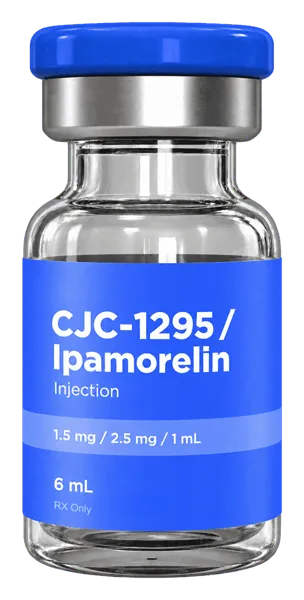
CJC-1295 and ipamorelin
Two peptides that push the pituitary to release more of the body's own growth hormone, through different switches.
- Long-acting analog of growth hormone-releasing hormone (GHRH)
- Selective growth hormone secretagogue acting on the ghrelin receptor
- Injectable peptides
- Small, short studies that measured GH and IGF-I, not muscle
If you are on testosterone therapy and lifting seriously, the question shows up almost on its own: could a growth-hormone peptide on top of TRT push recovery and recomposition further? It is a fair thing to wonder, and the honest answer is not a dosing tip. TRT and the GH peptides work on two different hormone systems, have very different amounts of evidence behind them, and have never been tested together in the studies people cite. This page separates the two cleanly, from a lifter’s point of view, using the clinical literature rather than forum stacks.
What do GH peptides add for a lifter already on TRT?
On paper they add a second hormone axis; in the evidence they add higher growth hormone and IGF-1 numbers, not proven muscle. CJC-1295 raised GH 2- to 10-fold and IGF-1 1.5- to 3-fold after a single injection in healthy adults, but those trials measured hormones, not muscle or strength (Teichman et al., 2006). No study cited here tested any GH peptide in men already on TRT.
Why do lifters on TRT ask about adding peptides?
The appeal is straightforward: TRT already improves body composition, so a second lever that works through a different hormone looks like a way to compound the effect. Testosterone therapy in men with low testosterone reliably shifts body composition: a meta-analysis of controlled trials in older men found a mean lean-mass gain of about 3.59 kg and a fat-mass reduction of about 1.78 kg, with injected testosterone producing larger lean-mass gains (about 4.78 kg) than oral routes (about 2.87 kg) (testosterone lean-mass meta-analysis, PMC). A separate review of men with testosterone deficiency reported significant, sustained weight loss and marked waist-circumference reduction on long-term therapy (testosterone and weight, PMC).
Once a lifter feels that, the reasoning goes: testosterone works on the androgen axis, so add something on the growth-hormone axis and stack the benefits. That is where CJC-1295 and ipamorelin enter the conversation, since they are marketed as the growth-hormone half of the stack. The instinct is understandable. The problem is that “works through a different pathway” and “adds a measurable result” are two separate questions, and the second one has not been answered for these peptides.
What do GH peptides actually do next to testosterone?
They act on a different system entirely, the growth-hormone axis rather than the androgen axis, which is exactly why the stacking idea sounds plausible. Growth-hormone secretagogues are designed to prompt the pituitary to release the body’s own growth hormone. CJC-1295 is a long-acting analog of growth-hormone-releasing hormone (GHRH) (Teichman et al., 2006), while ipamorelin is a five-amino-acid peptide that releases GH through the receptor used by the older growth-hormone-releasing peptides (Raun et al., 1998), which later research identified as the ghrelin receptor, GHSR1a (ghrelin pathway review, PMC). Ghrelin, the natural signal at that receptor, also stimulates appetite and fat storage (ghrelin pathway review, PMC). In principle the two peptides nudge two GH-release mechanisms at once, which is the synergy vendors describe.
The evidence level for physique use is best described as hormone-level human studies plus animal pharmacology. The human CJC-1295 trials ran 28 and 49 days in healthy adults aged 21 to 61, and their main outcome measures were GH and IGF-I, not muscle or strength (Teichman et al., 2006). Ipamorelin’s founding research was done in rat pituitary cells, rats and pigs (Raun et al., 1998). So “add a GH peptide to your TRT” is not the well-supported second lever it is sold as. For a deeper walk through the two peptides, see what CJC-1295 and ipamorelin actually do and how they differ in CJC-1295 vs ipamorelin.
Do GH peptides affect testosterone levels?
There is no human evidence that CJC-1295 or ipamorelin changes testosterone, and the animal evidence points away from it. Testosterone production is driven by two pituitary hormones, LH and FSH. In the founding ipamorelin research, none of the growth hormone secretagogues tested, ipamorelin included, affected LH or FSH levels in swine (Raun et al., 1998). The human CJC-1295 trials listed growth hormone and IGF-I as their main outcome measures (Teichman et al., 2006), so they do not address testosterone.
The practical takeaway for a lifter: on TRT, your testosterone level is set by your prescription and your labs, and a GH peptide is not a tool for changing it. If the question you are really asking is whether any peptide can replace or raise testosterone, our sister site covers that in peptides for men, which grades the common options and answers “what peptides increase testosterone?”, and in are peptides steroids?, which sorts peptides, anabolic steroids and TRT into their actual chemical classes.
What does TRT itself do for a lifter?
TRT is a treatment for diagnosed testosterone deficiency, and in that group it has the strongest body-composition evidence on this page. The lean-mass and fat-mass figures above come from 11 randomized placebo-controlled trials in 651 men over 60 with total testosterone at or below 550 ng/dL, treated for 12 weeks to 36 months (testosterone lean-mass meta-analysis, PMC), and the weight and waist changes come from men with documented deficiency (testosterone and weight, PMC). That caveat matters: the benefits were seen in men whose levels were low to begin with, not in men with normal levels chasing an edge. A good provider starts from your labs and symptoms rather than a goal to “run testosterone.” If you are weighing whether a supervised program fits your situation, our sister resource covers how TRT works online for men over 40, including what the visit and labs actually involve.
TRT vs GH peptides vs tesamorelin vs MK-677, side by side
The table lines up the four things lifters on TRT most often weigh. Read it as a map of the evidence, not a ranking: none of the cited studies tested any of the three GH-axis options in men already taking testosterone.
| Attribute | TRT (testosterone) | CJC-1295 / ipamorelin | Tesamorelin | MK-677 |
|---|---|---|---|---|
| Hormone axis | Androgen (testosterone replacement) | Growth hormone (GHRH analog plus ghrelin-receptor peptide) | Growth hormone (GHRH analog) | Growth hormone (oral ghrelin mimetic, not a peptide) |
| Headline research finding | Lean mass up about 3.59 kg, fat mass down about 1.78 kg in older men | GH up 2- to 10-fold and IGF-1 up 1.5- to 3-fold after one CJC-1295 injection | Labeled to reduce excess abdominal fat in adults with HIV and lipodystrophy | Fat-free mass up 1.1 kg vs a 0.5 kg loss on placebo at 12 months |
| Evidence level | Meta-analysis of randomized trials in men over 60 with total testosterone at or below 550 ng/dL | Small human hormone studies (CJC-1295); animal and cell studies (ipamorelin) | Approved drug, labeled use; physique use is off-label | Two-year randomized trial in healthy older adults |
| Muscle or strength shown? | Lean mass gain shown in trials | Not measured in the cited trials | Not part of its label; see our tesamorelin pages | Fat-free mass rose, but strength and function did not change |
| Main side effects in the cited research | Not covered by the cited body-composition sources | No serious adverse reactions in 28- and 49-day trials | Joint pain, injection-site redness and itching, swelling, muscle pain; glucose intolerance possible | Appetite increase, mild leg swelling, muscle pain; fasting glucose up, insulin sensitivity down |
Sources for the table: TRT (meta-analysis, PMC); CJC-1295 (Teichman et al., 2006) and ipamorelin (Raun et al., 1998); tesamorelin (Egrifta WR label, DailyMed); MK-677 (Nass et al., 2008).
Can you take tesamorelin while on TRT?
Tesamorelin is the one GH-axis option here with an FDA approval, but that approval covers a use that has nothing to do with lifting. It is a GHRH analog sold as Egrifta, and its label limits it to reducing excess abdominal fat in adults with HIV and lipodystrophy and states it is “not indicated for weight loss management” (Egrifta WR label, DailyMed). Using it for a physique goal on top of TRT is off-label, and no source cited here tested the two together.
The label is also the most formal side-effect record of any GH-axis compound on this page. Its most commonly reported adverse reactions were joint pain, injection-site redness and itching, pain in the extremities, peripheral swelling and muscle pain. It warns that fluid retention, glucose intolerance or diabetes may develop, tells prescribers to monitor IGF-1 because the drug raises it, and notes that long-term cardiovascular safety has not been established (Egrifta WR label, DailyMed).
If tesamorelin is the one you are weighing, we cover it from three angles: how it differs from the older GHRH fragment in tesamorelin vs sermorelin, what its trials actually measured in does tesamorelin build muscle?, and the label’s full adverse-reaction list in tesamorelin side effects.
What about MK-677 on TRT?
MK-677 (ibutamoren) gets grouped with peptides, but it is an orally active ghrelin mimetic, not a peptide. It has more human data than CJC-1295 or ipamorelin, and that data is a caution for lifters. In a two-year randomized, placebo-controlled trial in healthy adults aged 60 to 81, fat-free mass rose 1.1 kg over the first 12 months against a 0.5 kg loss on placebo, but in the authors’ words “Increased FFM did not result in changes in strength or function.” Fasting blood glucose rose by an average of 5 mg/dL and insulin sensitivity declined; the most frequent side effects were an increase in appetite that subsided within a few months and transient, mild lower-leg swelling and muscle pain (Nass et al., 2008). Our comparison of MK-677 versus GH peptides lays out that evidence in detail.
What side effects come with adding a GH peptide to TRT?
The honest answer is that the side-effect record for CJC-1295 and ipamorelin is short, and nothing cited here describes them in men on testosterone. The CJC-1295 trials reported no serious adverse reactions, but they lasted 28 and 49 days (Teichman et al., 2006), so long-term effects are unknown rather than known to be mild. Ipamorelin’s selectivity data come from animals: in pigs it did not raise ACTH or cortisol beyond what GHRH did, unlike the older GHRP-6 and GHRP-2 (Raun et al., 1998). What the small studies did record is collected in CJC-1295 and ipamorelin side effects.
The better-documented GH-axis compounds show what raising growth hormone tends to cost: fluid retention, joint and muscle pain, and pressure on blood sugar on the tesamorelin label (Egrifta WR label, DailyMed), and higher fasting glucose, lower insulin sensitivity and more appetite with MK-677 (Nass et al., 2008). For a lifter on TRT who already gets regular labs, that is a reason to tell the prescriber about anything added, so glucose and IGF-1 can be read in context. Our page on GH peptide side effects goes further.
Is CJC-1295 plus ipamorelin a good stack on TRT?
It is the most-discussed pairing, but “good stack” is a claim about results, and none of the studies cited here tested CJC-1295 and ipamorelin together, let alone on top of testosterone. The case for the pair is mechanistic: a GHRH analog and a ghrelin-receptor peptide press two different GH-release buttons (Teichman et al., 2006; Raun et al., 1998). That makes it a biologically reasonable hypothesis about GH, not a demonstrated body-composition outcome for a lifter whose testosterone is already managed.
What is the community saying about peptides on TRT?
We have no Community Insights summary built around TRT specifically, but our summaries of public posts on X about CJC-1295 (17 posts, July 13 to 19, 2026) and ipamorelin (16 posts, July 15 to 16, 2026) cover what lifters say about the GH half of the stack. These are anecdotes, not evidence.
- Stacking is the default. Commenters repeatedly list CJC-1295 plus ipamorelin as a go-to combination, and one post notes that most writing on it is either dry clinical summary or vendor material.
- Recovery stories come with big stacks. Users report faster recovery and physique changes, with one describing recovery with “unprecedented quickness,” but several of those running visible transformations were also taking many other compounds at once, which makes any single effect hard to isolate.
- Side effects people report. Flushing early on that faded at a lower amount, disrupted sleep with bloodshot eyes, and, for the GH peptides as a group, worries about insulin resistance and high IGF-1, though posters disagree on how serious those are.
- Tesamorelin as the comparison point. Commenters describe tesamorelin as the approved GHRH; one person said CJC-1295 won on cost but caused sleep problems that tesamorelin did not.
The full summaries live on our hub’s community pages for CJC-1295 and ipamorelin. The pattern lines up with the evidence above: the side-effect worries people raise (sleep, blood sugar, IGF-1) are the ones the better-studied GH compounds actually document, while the benefit stories rarely isolate the peptide from everything else in the stack.
The honest bottom line for a lifter on TRT
Keep the two apart and the decision gets clearer: TRT has solid trial evidence for body composition in men with documented deficiency, and the GH peptides people want to bolt onto it have small hormone-level studies, no physique trials, and no studies alongside testosterone. Adding CJC-1295 or ipamorelin to testosterone is not a proven optimization; it is adding a compound with thin evidence and short-term safety data, plus an ongoing cost, to a program that already has a clear basis. The move that actually serves your goal is to start from the outcome you want rather than a molecule to add.
If that outcome is better recomposition or recovery, bring it to the provider who manages your TRT, who can weigh what is evidence-supported and right for your labs. The same logic applies if you are leaning out: our guide on preserving muscle while losing fat on a GLP-1 shows how far the well-studied levers of protein and resistance training actually get you.
Status (CJC-1295 and ipamorelin): Not FDA-approved; sold by some telehealth providers as a compounded prescription. What this status means.
Educational information only, not medical advice. Every clinical statement on this page is sourced to the peer-reviewed literature and drug label linked above; the community summary reflects public posts on X analyzed in July 2026. Updated October 12, 2026. This page is drafted with AI assistance and fact-checked against the cited primary sources before publication.
Sources (7)
Advertising disclosure: links marked "Paid link" go to Bodybuilding Peptides (trybbpeptides.com), an affiliate destination, and Recomp Lab may earn a commission if you buy there. Our coverage is independent of that relationship, and nothing on this page is medical or legal advice.
 See it at Bodybuilding Peptides