The tesamorelin and ipamorelin blend: why it is sold as one, what each part does, and whether anyone has studied them together
The short answer
The blend pairs two peptides that raise your own growth hormone through different receptors: tesamorelin, a GHRH analog approved as Egrifta, and ipamorelin, a ghrelin-receptor agonist. An older human study showed that signals of those two types release more GH together, but we found no human study of tesamorelin and ipamorelin combined. Its effects are extrapolated from each part.
Most peptide blends are sold on a story: two ingredients, two jobs, one vial. The tesamorelin and ipamorelin blend has a better story than most, because the idea of pairing these two kinds of growth-hormone signal comes from real endocrinology research. It also has a gap that the marketing rarely mentions. This page explains what each half is supposed to do, where the pairing logic comes from, what has and has not been measured, and what people discussing these peptides online actually say.
What is the tesamorelin and ipamorelin blend?
The tesamorelin and ipamorelin blend is a single injectable product that contains two different peptides, each of which prompts the pituitary gland to release more of the body’s own growth hormone (GH). Tesamorelin is a synthetic version of growth hormone-releasing hormone (GHRH), the brain’s “release GH now” signal; the Egrifta label describes it as the full 44-amino-acid sequence of human GHRH with a small chemical group added to one end (Egrifta WR label, DailyMed). Ipamorelin is a five-amino-acid peptide that acts on a different receptor, the one the hunger hormone ghrelin uses, and was developed by Novo Nordisk as a selective GH secretagogue (Raun et al., 1998). Neither is growth hormone itself, and neither is a steroid.
Why are tesamorelin and ipamorelin sold together?
They are sold together because GHRH-type and ghrelin-type signals push GH release through two separate switches, and pressing both at once released more GH than either alone in an older human study. The key experiment was done in 1990 in 18 healthy men: low doses of a ghrelin-pathway peptide (GHRP-6) given together with natural GHRH produced a synergistic GH response, more than the sum of the parts, which the authors read as evidence that the two act independently (Bowers et al., 1990).
That is the whole rationale for the blend, and it is worth being precise about what it does and does not cover. The 1990 study used GHRP-6 and GHRH given once into a vein, and it measured blood GH over a short window. It did not use tesamorelin or ipamorelin, it did not run for weeks, and it did not measure fat, muscle or anything a lifter would see in the mirror. “These two classes add up for GH release” is supported. “This specific blend improves body composition” has not been tested.
What does tesamorelin do in the blend?
Tesamorelin is the half with real outcome data: in large trials it shrank visceral fat, the deep fat around the abdominal organs, and raised IGF-1. In a pooled analysis of two phase 3 trials in 806 adults with HIV and excess abdominal fat, 26 weeks of daily tesamorelin cut visceral fat by 15.4% relative to placebo, lowered triglycerides, and raised IGF-1 by about 108 ng/mL, with no significant change in the fat under the skin (Falutz et al., 2010). Outside HIV, a 12-month trial in 60 abdominally obese adults with reduced GH secretion found the same pattern: less visceral fat, better triglycerides and C-reactive protein, and no significant effect on subcutaneous fat (Makimura et al., 2012).
Evidence level in words: strong for what it covers. It is an approved drug with a labeled use backed by randomized, double-blind trials. A 2026 review of GH-axis peptides used by the fitness community placed tesamorelin alone in its top evidence tier, while noting that off-label uses remain unproven (Dominikowski et al., 2026). Our pages on whether tesamorelin builds muscle and on tesamorelin side effects go deeper, and the network’s tesamorelin overview covers the basics.
What does ipamorelin do in the blend?
Ipamorelin’s job in the blend is to add a second, ghrelin-receptor push on GH release, and its selling point is that it does this without raising stress hormones in animal testing. In rats and pigs it released GH about as strongly as the older peptide GHRP-6, but unlike GHRP-6 and GHRP-2 it did not raise ACTH or cortisol, even at doses far above those needed for GH release (Raun et al., 1998). That selectivity finding comes from animals, not people.
In humans, the record is small. A dose-escalation study in healthy men found ipamorelin has a short half-life of about 2 hours and produces a single GH pulse that peaked at about 0.67 hours (roughly 40 minutes) and then declined to negligible levels (Gobburu et al., 1999). Its published randomized efficacy trial, a phase 2 study, tested it for gut recovery after bowel surgery in 114 analyzed patients; it was well tolerated but did not beat placebo on the main outcome (Beck et al., 2014). Evidence level in words: early human pharmacology plus one negative phase 2 trial, with no body-composition data. See the network’s ipamorelin overview for more.
Has anyone studied tesamorelin and ipamorelin together?
No human study of tesamorelin and ipamorelin used together turned up in our searches. A PubMed search on October 12, 2026 for tesamorelin with ipamorelin returned seven articles, all of them reviews, and a ClinicalTrials.gov search for both names returned no registered trials. The 2026 review that ranked GH-axis peptides by evidence does not discuss this blend; it describes the closely related practice of pairing ipamorelin with CJC-1295 as “largely driven by anecdotal rationale,” with controlled evidence for synergy or body-composition effects in healthy people still limited (Dominikowski et al., 2026). PeptideAgent’s profile of the tesamorelin and ipamorelin blend reaches the same finding: it lists no published study of the combination and grades each ingredient on its own.
So the honest description of the blend is this: one well-studied ingredient, one lightly studied ingredient, a reasonable mechanism for why they might add up, and no data on the combination itself. Any specific claim about what the blend does for fat, muscle, sleep or recovery is an extrapolation from the separate parts and from older studies of related molecules.
Will tesamorelin get rid of belly fat?
Tesamorelin reduces visceral belly fat, the deep fat around the organs, but it has not been shown to reduce the fat under the skin that you can pinch. In the phase 3 trials visceral fat fell about 15% relative to placebo while subcutaneous abdominal fat did not change significantly (Falutz et al., 2010). The Egrifta label adds that it is not indicated for weight loss because it is weight-neutral, and that visceral fat came back in patients switched to placebo after 26 weeks (Egrifta WR label). Whether adding ipamorelin changes any of this has not been studied.
What are the side effects of the tesamorelin and ipamorelin blend?
The blend has no side-effect data of its own, so the best guide is each ingredient’s record plus the known effects of raising GH. For tesamorelin, the label lists injection-site reactions, joint pain, muscle aches, swelling and tingling, and warns about three bigger issues: blood sugar (an HbA1c of 6.5% or higher in 5% of patients on tesamorelin versus 1% on placebo), IGF-1 overshoot (47% of patients above two standard deviations at 26 weeks, with long-term effects unknown), and fluid retention it attributes to the rise in GH (Egrifta WR label). It is contraindicated in pregnancy and with active cancer.
For ipamorelin, the surgical trial reported adverse events at a similar rate to placebo (87.5% versus 94.8%, in very sick post-operative patients) (Beck et al., 2014). The 2026 review lists the class effects reported across GH-axis peptides used in fitness settings: hormonal shifts such as prolactin and cortisol changes, appetite changes, blood-sugar problems, fluid retention, joint and muscle aches, and injection-site reactions, and it flags uncertainty about product composition in unregulated supply (Dominikowski et al., 2026). Logic suggests that stacking two GH-raising signals could raise IGF-1 and its effects further than either alone, but that has not been measured. Both peptides are banned in tested sport: WADA’s list names tesamorelin among GHRH analogues and ipamorelin among growth hormone secretagogues (WADA Prohibited List).
Tesamorelin plus ipamorelin vs CJC-1295 plus ipamorelin
The two blends share ipamorelin and differ in their GHRH half, and that half is where the evidence gap is widest. Tesamorelin has phase 3 trials and an approval. The CJC-1295 in the published human studies is the long-acting “with DAC” version, tested in small dose-ranging trials that measured GH and IGF-1, not muscle or fat (Teichman et al., 2006), while the shorter “no DAC” version most often paired with ipamorelin has no peer-reviewed human studies at all, according to the 2026 evidence review (Dominikowski et al., 2026). Neither blend has been studied as a combination.
| Attribute | Tesamorelin | Ipamorelin | Tesamorelin + ipamorelin | CJC-1295 + ipamorelin |
|---|---|---|---|---|
| Type of signal | GHRH analog | Ghrelin-receptor GH secretagogue | GHRH analog plus ghrelin-receptor agonist | GHRH analog plus ghrelin-receptor agonist |
| Half-life | About 26 to 38 minutes (2026 review); 11 minutes for Egrifta WR (label) | About 2 hours | Not studied as a mix | With DAC: about 6 to 8 days; no-DAC version not studied in humans |
| Largest human evidence | Phase 3 trials, 806 adults with HIV; 12-month trial in obese adults | Phase 1 pharmacology; one phase 2 trial after bowel surgery | None found | Small dose-ranging trials of CJC-1295 with DAC; none of the pair |
| What was measured | Visceral fat, triglycerides, IGF-1 | GH pulse; time to tolerated meal (no difference from placebo) | Nothing | GH and IGF-1 levels |
| Evidence level in words | Approved drug, labeled use, large randomized trials | Early human studies, no body-composition data | Extrapolated from the parts | Small hormone-level studies; pairing anecdotal |
| WADA (sport) | Prohibited (S2) | Prohibited (S2) | Prohibited (S2) | Prohibited (S2) |
Table sources: Egrifta WR label, Falutz et al., 2010 and Makimura et al., 2012 for tesamorelin; Gobburu et al., 1999 and Beck et al., 2014 for ipamorelin; Teichman et al., 2006 for CJC-1295 with DAC; Dominikowski et al., 2026 for the tesamorelin half-life, the no-DAC evidence gap and the anecdotal basis of pairing; the WADA Prohibited List for sport status.
What is the CJC-1295 and ipamorelin peptide good for?
CJC-1295 and ipamorelin are used by lifters for recovery and body composition, but the human studies only show that they raise GH and IGF-1 levels; they do not show changes in muscle, fat or performance. The published CJC-1295 trials found dose-dependent rises in GH lasting six days or more and IGF-1 lasting over a week after a single injection in healthy adults (Teichman et al., 2006), and ipamorelin’s published phase 2 efficacy trial was negative. Our full guide to what CJC-1295 and ipamorelin do covers that stack in detail, and the CJC-1295 vs ipamorelin comparison explains why the two are usually paired.
What does the tesamorelin and ipamorelin blend cost?
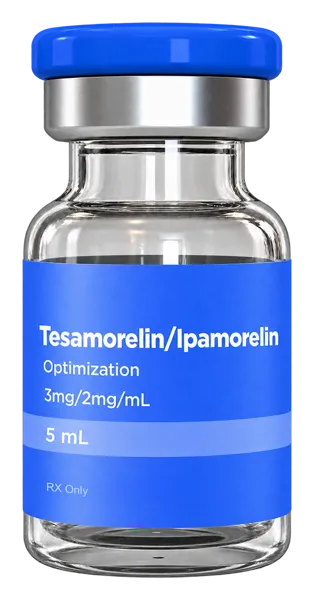
The blend has to be thought of as an ongoing monthly cost, because tesamorelin’s measured effects did not last after people stopped: in the label’s extension phase, visceral fat rose again in patients switched to placebo (Egrifta WR label). Egrifta, the approved brand of tesamorelin, is a prescription drug whose price depends on insurance and pharmacy; we have not verified a list price, so we do not print one. The premixed blend sold online is a separate, non-Egrifta product, and the “Where it’s sold” card on this page links to one listing.
One practical point applies to any premixed blend: the ratio of the two peptides is fixed by the seller. Buying the parts separately would let a prescriber adjust each one. Whether that matters for outcomes is, again, untested.
What the community is saying about tesamorelin and ipamorelin
We do not have a dedicated Community Insights sample for this blend, so this section draws on our summaries for ipamorelin (16 public posts on X, July 15 to 16, 2026) and CJC-1295 (17 public posts on X, July 13 to 19, 2026), where tesamorelin came up repeatedly. These are anecdotes and user opinions, not evidence.
- The two-switch idea is common knowledge. Posters draw the same GHRH versus GHRP distinction this page does, describing ipamorelin as a ghrelin mimetic that amplifies each GH pulse and tesamorelin as the only approved GHRH. That is the blend’s logic, stated by users.
- Ipamorelin as the “clean” starter. One widely shared post frames ipamorelin as a beginner-friendly peptide that avoids cortisol, prolactin and hunger effects. That claim lines up with the animal data, but the human evidence for it is thin.
- Prompting your own GH versus injecting it. Several users prefer secretagogues like ipamorelin and tesamorelin because they nudge the body’s own GH release rather than replacing the hormone, a distinction they present as a reason some prefer secretagogues over growth hormone itself.
- Tolerability and sleep. One user who compared GHRH analogs said CJC-1295 wrecked their sleep in a way tesamorelin did not, and another poster said secretagogues in general worsened their sleep. Users disagree.
- The worries. Insulin resistance and high IGF-1 are described as the two most cited fears about long-term GH peptide use, with some posters arguing they are overstated. Both are also among the risks the Egrifta label warns about.
What stands out is how closely the community’s reasoning tracks the mechanism research, and how little of it refers to measured results. None of the themes in these summaries mention a study of the blend, which fits what our search found: there isn’t one.
The bottom line on the tesamorelin and ipamorelin blend
The blend is built on a sound idea: two kinds of GH-releasing signal work through separate receptors and released more GH together in an older human study. Tesamorelin, the stronger half, has real trial data for visceral fat and a labeled set of risks. Ipamorelin has a short human record and no body-composition data. The combination itself has not been studied in people, so its effects, good or bad, are unknown beyond what each part suggests. If you are weighing it, the decision should rest on that record and on labs reviewed with a clinician.
Status (tesamorelin and ipamorelin): Tesamorelin is FDA-approved only as Egrifta, for HIV-related abdominal fat; other uses are off-label. Ipamorelin is not FDA-approved; it is sold by some telehealth providers as a compounded prescription. What this status means.
Educational information only, not medical advice. Every efficacy and safety statement on this page is sourced to the FDA label, peer-reviewed trials and reviews linked above, and the anti-doping statement to WADA; the community summary reflects public posts on X from July 2026. Updated October 12, 2026. This page is drafted with AI assistance and fact-checked against the cited primary sources before publication.
Sources (10)
Advertising disclosure: links marked "Paid link" go to Bodybuilding Peptides (trybbpeptides.com), an affiliate destination, and Recomp Lab may earn a commission if you buy there. Our coverage is independent of that relationship, and nothing on this page is medical or legal advice.
 See it at Bodybuilding Peptides