The growth hormone peptides lifters use are not in HHS's draft peptide policy. Here is what that means for a physique goal
The short answer
Nothing changed for the growth hormone peptides lifters use most. The draft HHS policy filed October 28, 2026 lists six peptides, and CJC-1295, ipamorelin, tesamorelin and AOD-9604 are not among them. Of the peptides lifters discuss, the ones on the list are the recovery peptides BPC-157 and TB-500 and the exercise-pitched MOTS-c, each only alone and under strict conditions. The draft is not an FDA approval, it is not binding, and it does not change the evidence or anti-doping status of any of these compounds.
Key takeaways
- The draft HHS policy filed October 28, 2026 is an enforcement position on compounding, not an FDA approval and not a binding rule.
- It lists six peptides: BPC-157, epitalon, KPV, MOTS-c, semax and TB-500. CJC-1295, ipamorelin, tesamorelin and AOD-9604 are not among them.
- The CJC-1295 and ipamorelin stack is out twice over, because neither peptide is listed and the draft covers single-ingredient products only.
- MOTS-c is on the list, but only alone, by injection and under strict conditions, and it is still prohibited in sport.
- The draft does not change the physique evidence or the WADA status of any growth hormone peptide.
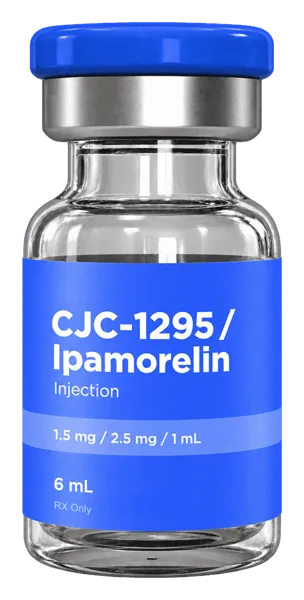
CJC-1295 and ipamorelin
Two peptides that push the pituitary to release more of the body's own growth hormone, through different switches.
- Long-acting analog of growth hormone-releasing hormone (GHRH)
- Selective growth hormone secretagogue acting on the ghrelin receptor
- Injectable peptides
- Small, short studies that measured GH and IGF-I, not muscle
News, filed October 28, 2026
This page covers a draft federal policy filed for public inspection on October 28, 2026, with Federal Register publication scheduled for October 30, 2026. It is commentary for lifters, not legal or medical advice. For the full policy, the ten conditions and the timeline, read our hub’s explainer.
In short: if your feed spent October 28 telling you “peptides are back,” check which peptides. The draft policy HHS filed that day names six.
The growth hormone peptides that dominate physique talk, CJC-1295, ipamorelin and tesamorelin, are not on the list, and neither is AOD-9604. For a lifter, the news is mostly about what did not change. This page walks through the compounds lifters ask about one by one, then explains why the policy says nothing about whether any of them builds muscle. The policy detail itself, including every condition, lives in the hub’s full explainer of the HHS draft peptide compounding policy.
What the October 28 draft actually does, in one paragraph
The draft is an enforcement position, not an approval and not a rule.
According to the Federal Register notice (FR Doc. 2026-22192, Docket HHS-OASH-2026-0496), HHS “does not intend to take enforcement action against a State-licensed pharmacy, Federal facility, or licensed physician compounding a drug product” using one of six listed peptides, when every condition is met. The six are BPC-157, epitalon, KPV, MOTS-c, semax and TB-500.
The notice says the policy “does not establish any rights for any person and is not binding on HHS or the public,” and both documents repeat that “compounded drugs are not FDA-approved, which means FDA does not review their safety, effectiveness, or quality before they are marketed.” It was filed October 28, 2026, with Federal Register publication scheduled for October 30, 2026, and HHS says it may revisit it if a safety signal or product quality issue arises (HHS policy text).
Which physique peptides are in, and which are out
Of the compounds covered on Recomp Lab, three appear on the HHS list: MOTS-c, and the recovery peptides BPC-157 and TB-500 that our peptides for muscle growth guide covers for the recovery half of the goal. The growth hormone peptides are absent from Appendix A, the list of six, so the draft does not reach them. The policy does not name the excluded peptides; they are out by omission.
| Compound | In the HHS draft’s list of six? | What that means |
|---|---|---|
| CJC-1295 | No | Status did not change |
| Ipamorelin | No | Status did not change |
| CJC-1295 and ipamorelin together | No | Two ingredients, and neither is on the list |
| Tesamorelin | No | Still FDA-approved only as Egrifta, for HIV-related abdominal fat; other uses are off-label |
| AOD-9604 | No | Status did not change |
| Sermorelin | No | Not covered by the draft |
| MK-677 | No | Not a peptide, and not among the six |
| MOTS-c | Yes | Alone, by subcutaneous or intramuscular injection only, under strict conditions |
| BPC-157 | Yes | Alone, in subcutaneous, intramuscular, oral or topical forms, under strict conditions |
| TB-500 | Yes | Alone, by subcutaneous or intramuscular injection only, under strict conditions |
| BPC-157 and TB-500 together | No | Two ingredients; the draft covers single-ingredient products only |
Source for the list and route limits: the HHS policy text, Appendices A and B.
Why the GH stack is out twice over
The CJC-1295 and ipamorelin pairing fails the draft on two separate counts. First, neither peptide is one of the six. Second, the draft’s conditions require that “the compounded drug product contains only a single Active Pharmaceutical Ingredient (API) listed in Appendix A” (HHS policy text). So even a hypothetical future in which one of them were added would not, under this draft, extend to a two-peptide product.
The same single-ingredient rule applies to the tesamorelin and ipamorelin pairing we cover in our page on the tesamorelin and ipamorelin blend.
This matters for physique readers because the stack is how these peptides are usually discussed: in our Community Insights summary of 17 public posts on X about CJC-1295 (July 13 to 19, 2026, collected before this news), pairing it with ipamorelin came up again and again as a go-to growth hormone combination. Those posts are anecdotes, not evidence, and nothing in the HHS draft speaks to the stack at all.
The exercise-pitched peptide on the list: MOTS-c
BPC-157 and TB-500 are on the list too, but lifters use them for injury recovery rather than for muscle or performance. MOTS-c is the one of the six pitched at training itself, and its place on the list is narrower than the headlines suggest.
Appendix B limits it to “appropriate subcutaneous or intramuscular injectable dosage forms,” it must be the only active ingredient, and every other condition applies, including a patient-specific prescription and a registered manufacturer with a tested certificate of analysis (HHS policy text). Two things did not move.
The evidence did not: the headline exercise results come from mice, and the one human experiment in that study measured the body’s own MOTS-c rising after a bike session rather than giving anyone the peptide (Reynolds et al., 2021).
And the sport ban did not: the WADA Prohibited List names MOTS-c under S4.4.1, and USADA says it is prohibited at all times (WADA Prohibited List; USADA). Our page on MOTS-c for athletes covers both in depth.
Status (MOTS-c): Not FDA-approved. Under a draft HHS policy filed Oct 28, 2026, HHS does not intend to act against licensed compounding of it alone, under strict conditions: injection only. What this status means.
The policy is about compounding, not about results
The draft is an enforcement position on compounding, not a review of whether any peptide works. That distinction is the most useful one for a lifter to hold onto, because a headline about access can easily be read as a headline about effectiveness. The physique evidence for the growth hormone axis is where it was on October 27:
- CJC-1295. The published human data are small pharmacology trials in healthy adults that measured growth hormone and IGF-1, not muscle, strength or fat (Teichman et al., 2006).
- Ipamorelin. Its most rigorous human test was a randomized trial in bowel-surgery patients, which did not beat placebo on its primary endpoint (Beck et al., 2014).
- Tesamorelin. Its trials in adults with HIV measured visceral fat and IGF-1; lean body mass rose about 1.2 to 1.3 kg on DXA and fell back after stopping (Egrifta WR label, DailyMed).
None of that is affected by a compounding policy, and none of it would be even for a peptide that is on the list. For the full read on what these compounds can and cannot do for body composition, see our guide to growth hormone peptides for physique.
Is CJC-1295 or ipamorelin one of the six peptides in the HHS draft?
No. Appendix A of the HHS policy is a numbered list of exactly six peptides (BPC-157, epitalon, KPV, MOTS-c, semax and TB-500), and neither CJC-1295 nor ipamorelin is on it (HHS policy text). Their status did not change on October 28. The hub’s guide to what peptides are lists the peptide medicines that do carry an approval. Our pillar on what CJC-1295 and ipamorelin actually do covers the mechanism and the human data.
Status (CJC-1295): Not FDA-approved. Not one of the six peptides in the draft HHS compounding policy filed Oct 28, 2026, so its status did not change. What this status means.
Status (ipamorelin): Not FDA-approved. Not one of the six peptides in the draft HHS compounding policy filed Oct 28, 2026, so its status did not change. What this status means.
Does the HHS draft cover tesamorelin?
No. Tesamorelin is not among the six, so the draft does not reach it. Tesamorelin is also in a different position from the other growth hormone peptides here, because it is an FDA-approved drug under the brand Egrifta, with a label limited to reducing excess abdominal fat in adults with HIV and lipodystrophy (Egrifta WR label). Using it for physique goals is off-label, and the October 28 draft does not change that. Our page asking does tesamorelin build muscle grades the muscle claim against the trials.
Status (tesamorelin): FDA-approved only as Egrifta, for HIV-related abdominal fat; other uses are off-label. The draft HHS peptide policy filed Oct 28, 2026 does not cover it. What this status means.
Is AOD-9604 covered by the HHS draft?
No. AOD-9604 is not in Appendix A, so the draft does not cover it and its status did not change (HHS policy text). The draft does not name it; it is out by omission, like every peptide not on the list of six.
Does the policy change anything for tested lifters and athletes?
No. The federal draft says nothing about sport, and anti-doping status is set by WADA, not HHS. CJC-1295, ipamorelin and tesamorelin sit in WADA’s S2 class of growth hormone releasing factors and secretagogues, and MOTS-c is named under S4.4.1 (WADA Prohibited List). A pharmacy label makes no difference to a drug test. If you compete under an anti-doping code, the October 28 news does not open any door.
Can I now get a growth hormone peptide from a compounding pharmacy because of this?
Not because of this draft. It covers only the six listed peptides, each alone, and only when a state-licensed pharmacy, federal facility or licensed physician meets every condition, including a patient-specific prescription. It also has no stated effective date beyond the filing on October 28 and scheduled publication on October 30, 2026 (Federal Register notice). State rules still apply and vary, and the federal draft does not change them. For the growth hormone peptides covered on this site, the draft offers nothing new.
What should lifters watch for next?
Watch the comment period and any future FDA rulemaking, and treat everything else as unknown. The notice says written comments can be submitted until two weeks after Federal Register publication, through regulations.gov on Docket HHS-OASH-2026-0496 (Federal Register notice). It also says FDA’s future rulemakings “may propose adding some or all of these peptides” to the 503A bulks list, and “these peptides” means the six. Whether any excluded peptide, including the growth hormone peptides, ever gets a later review is not known. The hub keeps the running explainer updated as the Federal Register posts its dates.
How this page is sourced
Every regulatory statement on this page comes from the two primary documents: the Federal Register public inspection copy and the HHS policy text with Appendices A and B. The evidence statements reuse the same primary studies, label and anti-doping list cited across Recomp Lab, linked inline. The community theme comes from our Community Insights summary of public posts on X about CJC-1295, collected in July 2026, before this news, and labeled as anecdote. This piece is drafted with AI assistance and fact-checked against its cited primary sources.
Educational commentary only, not medical or legal advice. Published October 28, 2026, the day the draft was filed; we will update it when the Federal Register posts the notice and its comment deadline.
Frequently asked questions
Is there a peptide ban?
The October 28, 2026 HHS draft is not a ban and not an approval; it is a non-binding enforcement position on compounding. HHS says it does not intend to take enforcement action against licensed pharmacies, federal facilities or physicians compounding one of six listed peptides when every condition is met. Peptides not on the list, including the growth hormone peptides, are out by omission and their status did not change.
Is ipamorelin FDA approved?
No. Ipamorelin is not FDA-approved. It is not one of the six peptides in the draft HHS compounding policy filed Oct 28, 2026, so its status did not change.
Is CJC-1295 FDA approved?
No. CJC-1295 is not FDA-approved, and it is not one of the six peptides in the draft HHS compounding policy filed Oct 28, 2026, so its status did not change. A CJC-1295 and ipamorelin product would also fall outside the draft, which covers single-ingredient products only.
Is tesamorelin FDA approved?
Yes, but only as Egrifta, for HIV-related abdominal fat; other uses are off-label. The draft HHS peptide policy filed Oct 28, 2026 does not cover it. Our page on tesamorelin side effects covers what the Egrifta label lists.
Are peptides legal in sport?
The HHS draft says nothing about sport; anti-doping status is set by WADA. CJC-1295, ipamorelin and tesamorelin sit in WADA's S2 class of growth hormone releasing factors and secretagogues, and MOTS-c is named under S4.4.1. A pharmacy label makes no difference to a drug test.
Sources (9)
About the editorial team
Advertising disclosure: links marked "Paid link" go to Bodybuilding Peptides (trybbpeptides.com), an affiliate destination, and Recomp Lab may earn a commission if you buy there. Our coverage is independent of that relationship, and nothing on this page is medical or legal advice.
 See it at Bodybuilding Peptides